
A certificate of analysis can contain a lot of information on one page. The useful starting point is to establish which sample it describes, what was tested and how the reported results compare with the stated requirements. Once those pieces are clear, the percentage figures become much easier to interpret.
Start with the report details
A certificate of analysis, usually shortened to COA, records tests and results for an identified sample. It normally also states the criteria used to judge those results. WHO's model certificate provides a useful reference for this structure, although it was developed for pharmaceutical quality-control laboratories; citing it does not establish that a research reagent or its report meets pharmaceutical requirements.WHO certificate model (opens in a new tab)
Before reading the results, compare the material name, vial size and batch or lot number with the item you are checking. A familiar compound name is only part of the match. If the report describes a different lot, ask the supplier to explain the connection rather than assuming it applies.
Also find the issuing laboratory, report identifier, revision and relevant dates. These details help you refer to the right document if a question arises. Keep a copy of the complete PDF so that its notes and conclusion stay attached to the result table.
Keep identity, purity and content separate
These measurements answer different questions. Reading them together is more informative than choosing the largest percentage on the page.
- Identity
- Does the tested material match the reference or identity criteria used by the laboratory? Read the method and the wording of the conclusion.
- Chromatographic purity
- What share of the integrated chromatographic signal is attributed to the main component under the stated method? Check whether the result is expressed as an area percentage.
- Measured content
- How much of the specified material was measured? On this example it is reported in milligrams per vial, separately from chromatographic purity.
An HPLC or UHPLC area percentage is not a direct measurement of everything in the vial by weight. Water, counterions and residual solvents may require other measurements. Likewise, a percentage described as net peptide content has its own basis and should not be read as an interchangeable purity result.Bachem analytical guide (opens in a new tab)
Identity also depends on the ability of the method to distinguish the intended material from alternatives. ICH's analytical-validation guidance explains that more than one procedure may be needed when a single method does not provide enough discrimination. A report naming LC-MS or LC-HRMS should therefore be read with its reference and identity criteria, rather than as an unlimited guarantee of structure.ICH Q2(R2), section 3.1 (opens in a new tab)
Walk through a supplied certificate
The example is the Semax 10 mg report currently supplied on our product page: report MA-PEP-0041, revision 01, task DMAS3J7, lot PEP-41-3J7. We are using it to explain how to read the document. The values below are transcribed from that report, not new measurements or an independent verification of its issuer or findings.Semax report (PDF) (opens in a new tab)
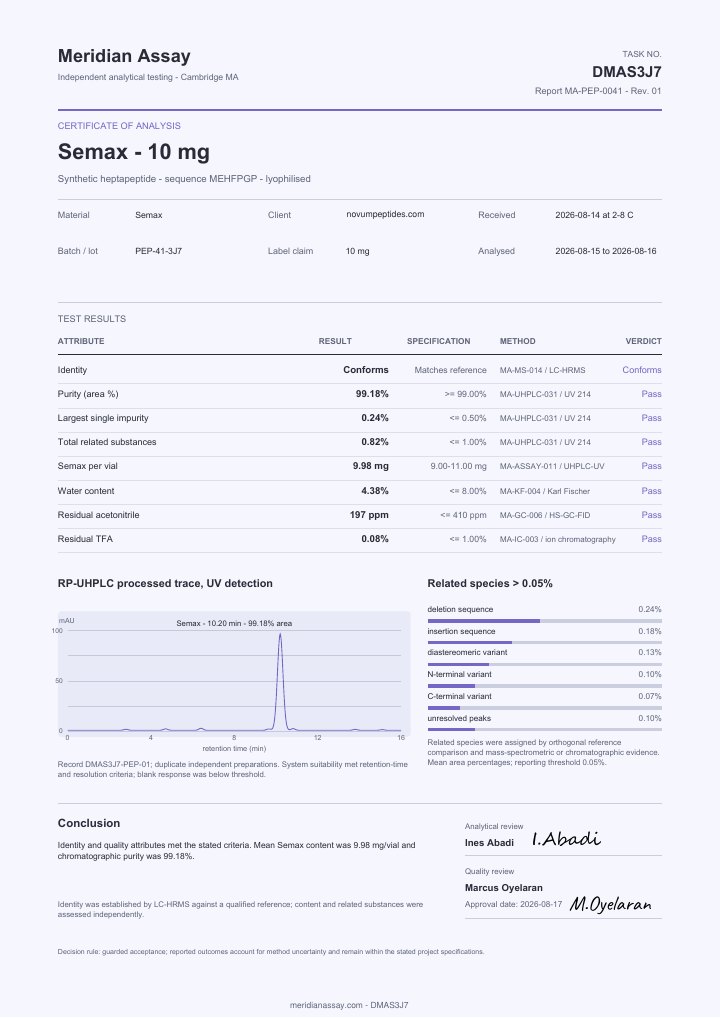
Find Semax, the 10 mg label claim and lot PEP-41-3J7. Compare these with the item you are checking. Receipt and analysis dates describe separate events.
Open the full certificate (PDF, opens in a new tab)Highlights are a reading aid over the supplied document. The linked PDF is unchanged.
Read across a row, rather than stopping at the result. The specification states the requirement applied; the method identifies how the measurement was made; the verdict records the laboratory's assessment.
| Reported attribute | Result | Stated specification |
|---|---|---|
| Identity | Conforms | Matches reference |
| Purity (area %) | 99.18% | ≥99.00% |
| Largest single impurity | 0.24% | ≤0.50% |
| Total related substances | 0.82% | ≤1.00% |
| Semax per vial | 9.98 mg | 9.00–11.00 mg |
| Water content | 4.38% | ≤8.00% |
Here, 99.18% is above the report's minimum purity specification of 99.00%, while 9.98 mg falls within its stated content range of 9.00–11.00 mg. That explains the two passing results. The ranges belong to this report: they are not universal acceptance limits for every peptide or research project.
The water result is reported using a different method, Karl Fischer. It should not be added to the chromatographic impurity percentage as though both were parts of the same total. The PDF also lists residual acetonitrile and TFA; this shortened table is a reading aid, so consult the full report for every result and its method.Semax report (PDF) (opens in a new tab)
Use the chromatogram as supporting information
A chromatogram plots detector response against retention time. In UV chromatography, an area-purity result is based on integrated peak areas under the method used. The plotted height of the tallest peak is not, by itself, the purity calculation.Bachem analytical guide (opens in a new tab)
The example labels the main Semax peak at 10.20 minutes and gives its area as 99.18%. It also lists related species and states a reporting threshold of 0.05%. Those notes matter: the image is a processed trace with a defined reporting scope, not a complete description of every substance that could be present.Semax report (PDF) (opens in a new tab)
Read the trace alongside the numerical results, method and notes. A large, clean-looking peak does not replace the separate identity or content result. If you need to assess the analytical work in more depth, ask what underlying data and method details are available.
Check what the report leaves unanswered
A passing conclusion applies to the tests and criteria stated in that document. It should not be expanded into a claim about a different lot, every vial in a shipment or a property that was not measured.
For example, this Semax certificate lists no sterility or endotoxin result. Its purity result does not supply either missing measurement. It also does not establish shelf life, stability after preparation or suitability for human or veterinary use.Semax report (PDF) (opens in a new tab)
Sampling matters too. The example mentions duplicate independent preparations, but that wording alone does not tell you how many vials were sampled across the lot. If your work depends on batch-wide representativeness, ask for the sampling information rather than assuming that repeated preparations are separate randomly selected vials.
Reading the report and verifying its provenance are separate tasks. For an authenticity question, seek confirmation of the report identifier and version through an independently located contact for the issuing laboratory. A logo, signature image or a plausible-looking result is not a substitute for that confirmation.
A final check before you rely on a COA
- The material name, vial size and lot match the item you are checking.
- You can identify the issuing laboratory, report number and revision.
- You have read identity, purity and content as separate results.
- Each result has been considered with its method, units and stated limit.
- You have checked the notes, dates, sampling information and conclusion.
- Any missing test or unresolved detail has been recorded as a question, not assumed to have passed.
On Novum product pages, choose the vial size before opening the certificate. If something needs explaining, send the product name, size, lot and report identifier, along with the specific row or wording you are asking about. That gives us a clear starting point for reviewing your question.
Sources and further detail
- Supplied Semax 10 mg certificate (opens in a new tab)
MA-PEP-0041, revision 01; task DMAS3J7; lot PEP-41-3J7. Source of the example, figures and document-specific observations.
- WHO — Model certificate of analysis (opens in a new tab)
Technical Report Series 1010, Annex 4 (2018). Background on report structure; not an endorsement of this material or certificate.
- Bachem — Quality control of amino acids and peptides (opens in a new tab)
Sections on identity, purity and product content. Used for the distinction between chromatographic area and material content.
- ICH — Q2(R2): Validation of analytical procedures (opens in a new tab)
Final guideline, 1 November 2023; section 3.1. Background on specificity and selectivity, not evidence that the supplied methods have been validated to this guideline.
External sources accessed 19 September 2026. The example explains the supplied report; it does not independently authenticate the document or its results.